


One of the biggest questions I get from athletes and everyday movers alike is this: how do I know when to make an exercise harder? Progression can feel confusing. Some weeks you feel strong, other weeks you feel flat, and the idea of adding more weight or reps can feel vague or even intimidating.
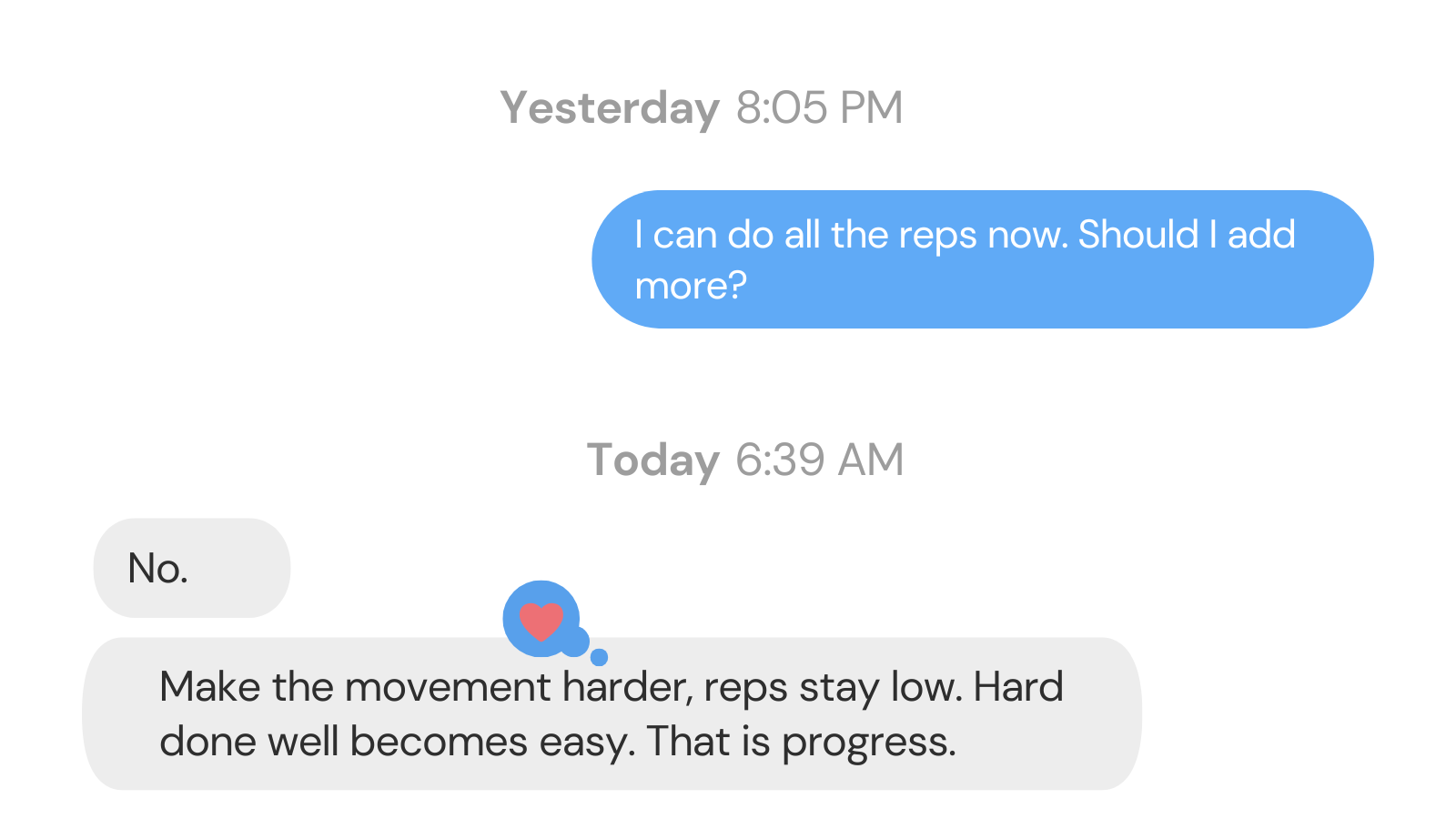
The good news is that the research on exercise difficulty gives us a clear and practical way forward. You do not need complex percentage charts or advanced training equations. You need a simple target and a repeatable progression strategy.
What level of difficulty gets results
Strength and power improve when your muscles and nervous system are challenged at the right level. Not maximal effort. Not exhaustion. The sweet spot is this:
Exercises should feel moderately hard.
At moderately hard intensity you are usually finishing a set with two to three reps still in the tank. This is what strength coaches call RIR. For our purposes it means this: you could have done a couple more reps if you had to, but you are glad you did not.
That zone consistently produces gains in strength, power, and functional capacity without beating you up or creating unnecessary fatigue.
Why more difficult exercises actually feel easier overall
As exercises get more challenging something interesting happens. You need better neuromuscular control. You cannot rush the movement. You lower the reps per set. And because you are doing fewer reps the total fatigue often drops even though the exercise is harder.
More difficult exercises tend to give you:
Better neuromuscular coordination
More functional carryover
Less overall fatigue
More pure strength and power
Less bulky muscle development
Harder does not mean heavier and longer. Harder means more skilled. Think of it as leveling up your nervous system rather than hammering your muscles.

What does a realistic progression look like
Progression always depends on your starting point. Research shows that the first strength gains you experience come from your nervous system becoming more efficient. These early changes show up fast. Actual muscle remodeling takes longer.
Neuromuscular improvements begin in the first two to three weeks. Physiological changes like thicker, stronger muscle fibers take six to eight weeks and continue from there. This means your job early on is simple: learn the movement and hit the right intensity consistently.
Here is the practical approach we will use throughout this training series.
Your progression roadmap
Increase reps until you reach 8 with solid form at 2 to 3 RIR
Once you hit 8 reps easily enough to keep those two to three reps in reserve, increase the load
Add a plate or increase by roughly 10 to 15 percent
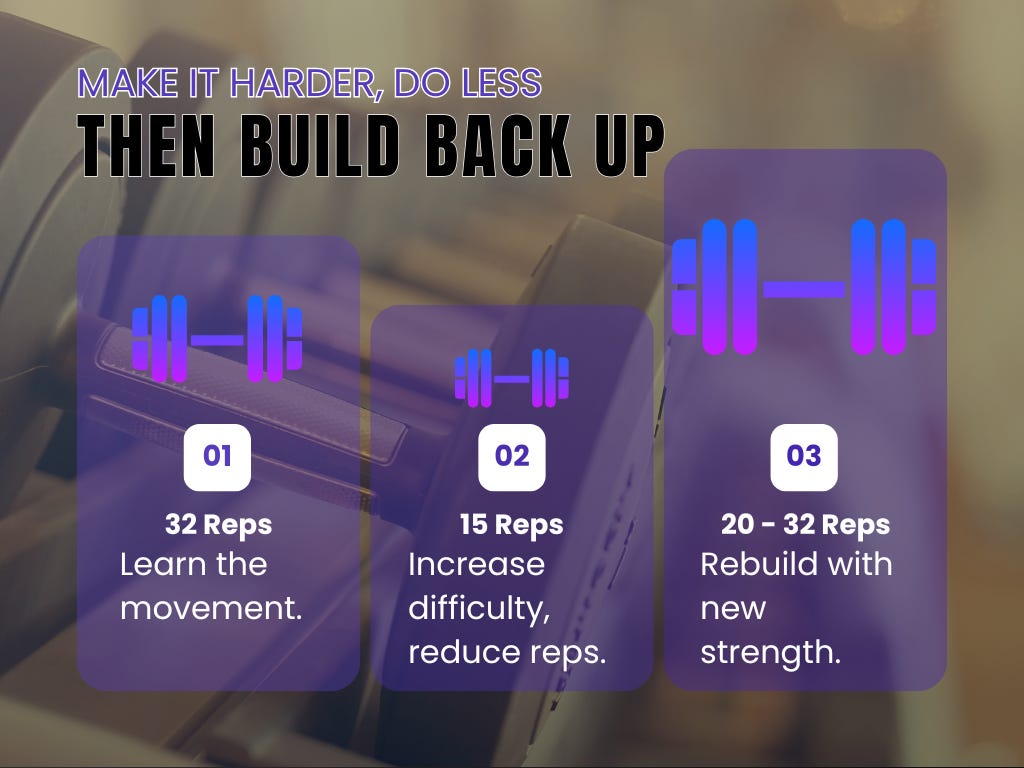
When you make the exercise harder, reduce the workload
Drop from 4 sets to 3 sets
Drop reps from 8 to 5 to 6
Notice what happens
Your total rep count goes from 32 down to 15
You are doing less volume
You recover faster
But the stimulus is stronger
Then you work your way back up again. Reps first to 8, then temporarily bump up to a 4th set while dropping reps again to 5. As you settle in, you return to the full 4 by 8 structure and repeat the cycle.
This is how athletes build sustainable strength across decades. Progress slowly, skillfully, and consistently.
This Week’s Workout
Back to Week One with Better Precision
This week we circle back to the structure of Workout One, but now the emphasis shifts to intensity. We are dialing in the right difficulty for the squat. The sit to stand you learned in Week One should now become a goblet squat or a back squat with weight.
Your goal is not to do more. Your goal is to do the right amount at the right effort.
Workout #5: Orientation plus Intensity Dial-In
Walking Speed Focus
Purpose: Reinforce the foundational movements that build gait efficiency while practicing the skill of training at a moderately hard intensity.
Frequency: Twice this week
Duration: 45 minutes
Goal: Continue building the qualities that improve walking speed while progressing your squat to a loaded variation.
Block 0: Prehab and Warm-Up (5 to 6 min)
Mobilize hips and ankles, raise heart rate, and coordinate arm leg rhythm.
Standing March with Arm Swing
2 by 30 seconds
Focus on smooth coordination and tall posture
Ankle Rockers into Calf Raise
2 by 10
Improve ankle mobility and push-off power
90/90 Breathing Standing or Seated
2 minutes
Reset posture, lengthen your breath, and anchor your rib position
Block A: Big Rocks (Strength Foundations)
Train the major muscles that drive walking speed and endurance.
Goblet Squat or Back Squat
3 by 8
Pick a load that feels moderately hard with 2 to 3 RIR. Sit to stand is behind you now. Move with control, keep your feet quiet, and aim to finish strong.
Farmer Carry
3 by 20 meters
Carry a light to moderate load. Tall spine and smooth steps.
These are your engine builders. Strong legs and a stable core make every step more efficient.
Block B: Fine Tuners (Balance and Control)
Sharpen proprioception and postural control.
Single Leg Balance with Head Turns
2 by 20 seconds each leg
Maintain steady breathing and soft knees
Hip Hinge with Dowel
3 by 8 each side
Maintain a neutral spine and keep your weight mid foot. Try not to let the free foot touch the ground.
Block C: Functional Flow (Gait Endurance)
Integrate strength and balance into smooth, rhythmic movement.
Step Up on 8 to 10 inch platform
3 by 30 seconds
Alternate lead foot. Drive tall. Full foot contact.
Brisk Walk or March into a Short Skip
3 by 30 seconds
Simulate your six minute walk test rhythm at RPE 6 to 7
Block D: Recovery and Reset (5 min)
Cool down and reinforce coordination.
Supine 90/90 Breathing
2 minutes
Relax and restore
Pelvic Clock
Untimed
Slow and smooth movement to reset neuromotor control
Looking Ahead
This week was all about learning how to dial in difficulty. Not chasing fatigue, not piling on reps, but finding that sweet spot where the work feels moderately hard and your body adapts without being overwhelmed. It is the skill that keeps people progressing for decades.
Next week we will revisit Week Two with a light progression. Nothing dramatic. Just enough added challenge to keep your nervous system learning and your strength curve moving upward. Expect a small bump in complexity, a touch more balance work, and a little more intention during the strength block.
After that we will begin layering in joint specific progressions for your knees, hips, spine & other joints like I’ve started with the Elbow reset, here:
These will show you how to tune the Longevity Workout approach to your body’s needs in the moment. I will also be adding a dedicated series centered on women’s health and performance, especially around perimenopause and menopause where the research is clear that strength, power, and consistency matter more than ever.
Stay tuned, stay curious, and stay in motion.